Wednesday, November 17, 2010

Response for Nov 18th

I think for the most part Castells seems to be saying that while there are a lot of implications on society because of all of these new information and communication technologies appearing in the world, it isn't necessarily a bad thing.  The implications that he talks about have to do with the fact that with these new technologies the rate and span of what we can do has gotten faster and larger.  We can now communicate so much faster and with so many more people that it's bound to have an impact.  One impact I thought was pretty interesting was that these technologies have an impact on the economy giving us more of a global economy.  This has implications in the working world because now we rely more heavily on networking and getting things done almost in real time instead of having delays.  Workers now need to be able to easily adapt from one thing to another in order to stay in the working world.  I think I agree with Castells that this isn't such a bad thing.  I think one of the ways we can progress in a society is by being able to adapt and manipulate our own skill sets.  I think this adaptability will help us grow as a society.

Another interesting implication is in the world of education.  Because of the impact of these technologies, the role of education all of a sudden becomes more important, which personally I think is wonderful and refreshing.  It does mean, however, that the school system needs to go through a transformation so that the information people are learning is actually relevant to the society they now live in.  While I think there is a lot of cross over between important information previous generations learned and important information for future generations, I also think that the world is changing and so education needs to adapt to the new world.

Also, just because we are creating all of these great communication devices and creating all of these online societies, I don't think it means that real world societies are disappearing, but again, they may need to be able to adapt to a new system.  The old societies won't become obsolete just because there are new ways of communicating and forming relationships.  I think we have to work hard, however, at transforming our current mindsets and ideas about society so that we can bring them into the future and mesh together the new technologies with our former lives.

Tuesday, November 9, 2010

Response for Nov 11th

I think for my final project is that I would like to expand on the article that I did for my critique and especially focus more on social networking medias that were not created for the purposes of education but that have been adapted into useful tools for education.  For example of all the different medias presented in the article I looked at, there were quite a few that I never would have thought of as being educationally valuable, but I realize that that was in incorrect assumption.  I would never have imagined Flickr, for example, being used for classes but I can see from the description of it that it really could be good for sharing images and holding discussions about those images.

I'm not entirely sure what resources I could use, I know the same article would be a good springboard and there are probably a lot more articles in journals of technological resources.  I was thinking I could also include Second Life because that is another example of a platform that was not at all created for educational purposes but has been morphed to be used as such.  I think there is also an interesting debate as to whether if something was not created as an academic tool if using it as one is valuable to students.  I tend to think that when students are able to use tools that they maybe already know from a non-educational perspective that they would be more apt to think of the lesson as something fun and would not have the same first impression of the lesson that they might if they could see right away that the platform was "educational".  I'm also thinking that this topic would have to be used with a literature review and I think I could find some good articles in different journals about educational technology.  Already I think there is a lot of resources I could find by looking at what is cited in both my article and perhaps some of the articles that other people critiqued for class.  I think this could be a very interesting topic to dive into.

Tuesday, November 2, 2010

Response for Nov 4th

I've touched on this before, but I think it is really interesting to think about the idea of how truthful people are on the internet and especially when you're talking about a social networking site.  It seems like people are more or less truthful depending on what the social networking site is geared towards.  I would think that on dating sites, like the article "The Truth about Lying in Online Dating Profiles" was about, there would be more misrepresentation of ones self because it is a location where the person would want to present the best part of themselves in order to be considered more attractive to those looking at their profile.  Whereas, on somewhere like facebook, or maybe a different network site that is only used by people who already know each other, people might be less prone to misrepresenting themselves because if they are friends in real life with all the people they are friends with online, then clearly they don't really have anything to hide.  I think Linked In (though I'll admit I've never been on the site) might be more similar to the dating sites where people want to give the best representations of themselves because they want to look attractive, well a different kind of attractive in this case but still, they want to seem like the "right" kind of person to whomever is viewing their profile.

I think this then leads into the problem that I talked about last week in that what do you do when how you want to portray yourself is changed by either you relationships or what other people are posting about you etc.  I think danah boyd's article really made it explicit when she talked about how online social networking sites tend to give flattened representations of what is a friend.
I think one way that we have of coping with these flattened representations is by having networks that are solely devoted to professional or solely devoted to finding a mate or just for keeping in touch with friends or anything else that might be a smaller subset of the relationships that people form in the real world.  But even with all of the different networking sites out there, it still can become hard to separate them.  Even, like it was saying in the article, Friendster started similar to a dating site, but moved onto to someplace where friends with mutual interests could stay in touch.  Facebook as well started as a place for college students to network with each other and morphed into an interesting dichotomy of both a place for friends to keep in touch but also a place for businesses to advertise and function.  It's easy to forget, when you're on a social networking site, who else can view your profile and the information you're displaying.  Or, it might not even be the information you're displaying, it might be information people who are linked with you are displaying, which then reflects on you. 

I think this is all important information to realize when you're working with online social sites, especially when it relates to education.  I think its important because it can cause privacy issues for students and teachers alike, which of course is something everyone is striving to prevent.  I think social networking sites can be really engaging and become an important pool of knowledge, but there is still that element of caution that needs to be applied to any situation online.

Tuesday, October 26, 2010

Response for Oct 28th

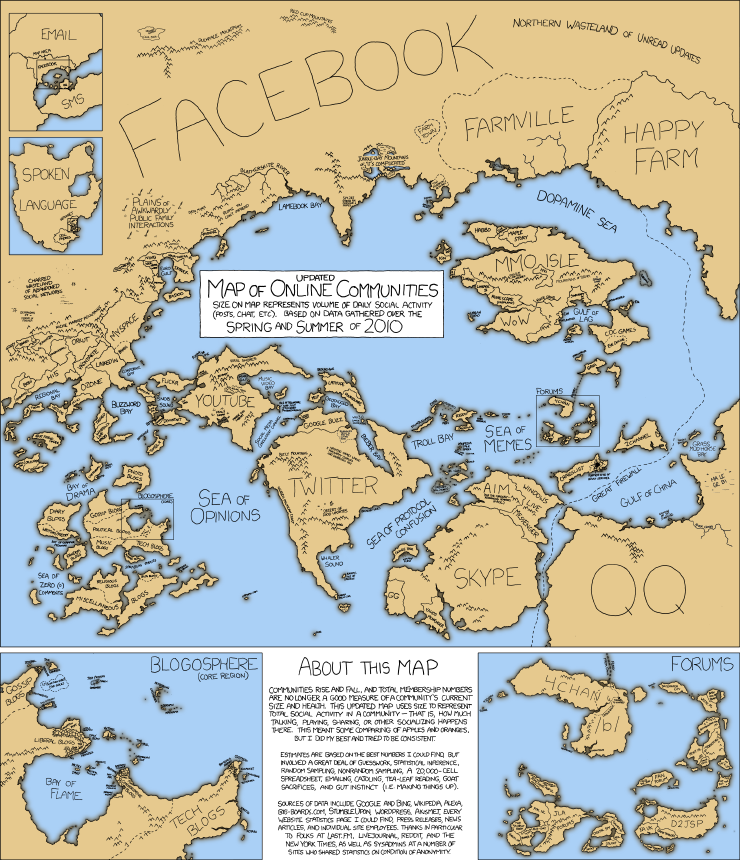
Before I respond to the prompt, I wanted to share with everyone the following webcomic where they actually made a map of all the online communities.  It's taken from a webcomic called XKCD that deals with a little bit of everything, but definitely talks a lot about technology and computers.  I know that it is a little bit small to read so I definitely suggest checking out the original site at http://xkcd.com/802/

I thought this map was a very interesting way to think about the idea of social networks and really how popular they are and how many millions of people use them on a daily basis.

Getting back to the readings, one of the things I found most intriguing about this weeks readings was the idea of social networking and public versus private information as well as the effect that this has on the connections we make.  I was especially interested in the idea of the distinction between professional and personal.  I think especially because I know so many soon to be teachers it is an important distinction to make when it comes to online social networking.  I think every person has different sides of themselves, and not because they are purposely deceiving their friends and family but I think everyone needs different sides of themselves depending on the occasion.  For example I would act a slightly different way with my best friends than I would with my coworkers or with my family.  Sometimes I think those personas can overlap, but for the most part they tend to stay separate.  Going back to the example of the teacher.  If a teacher lets their students into their personal life then they are changing the student-teacher relationship into something else, which can mean that some of the fundamental ideas that happen in that relationship may disappear.  Certain relationships are the way they are because they exist for a specific purpose.  The student-teacher relationship exists in order to help give the teacher the respect and power they need in order to teach.  When you start to blur the lines between those different relationships the fundamental ideas start to vanish and can hinder the working relationship the two people have.

It kind of reminds me of the book "My Teacher Sleeps in School" because in that book the student-teacher relationship is clearly identified.  It would be a very different situation if the student could just look at facebook and see pictures of their teachers home or something like that.


To bring the idea to a different example I think about my own online social networking style.  I know that people use facebook as their professional profile.  For me, I could never do that.  I use it strictly for personal use and even go so far as to block different types of information about myself to anyone who should not have access to that part of my life.  I think thats why it is important for sites such as Linked In to exist so that there can be those clear cut lines between the professional realm and the private realm.

Wednesday, October 20, 2010

Response for Oct 21st

After reading the article that I critiqued for last week (about utilizing social networking media to appeal to newer generations of learners) I have really become interested in how websites and programs that are really made for entertainment sharing purposes from the start can then become implemented into educational design.  For example, I would never have thought of Flickr as being useful when it came to education, but as I found out through the article and during the last class, it actually has been used in classes and can be a great platform for sharing images and for creating discussion about those images.  I think it's great that we as educators can take existing programs that are just free and out there on the web and then be able to mold them for educational purposes.  I don't think the creators of Second Life, for example, were thinking they would spawn this niche as an online education meeting space when they first created this virtual world.  (Or maybe they are, I could be wrong ^_^)

I think as I move forward I need to find readings that research more of these programs in depth.  I think the overview gave me a good starting point and then I can dive into some of the areas the article was talking about.  I would also be interested in looking at how the different types of media play against each other.  For example, how is something like YackPack (basically asynchronous voice messages) help in an educational setting versus something like a text based discussion board.  Is one better than the other in general?  Or would it depend on the situation?  I also think it would be interesting to expand further on the idea of a "neomillennial learner", whether such a thing even exists, and/or how that effects teaching methods.

Tuesday, October 5, 2010

Response for Oct 7th

One of the themes that seems to pop up in my writing is the idea of how we should and do relate to technology and whether or not we drive it, or it drives us. I do realize how broad of a topic this is, but I think it is an important one that perhaps we as humans are still finding out. I think that seems to be at the heart of many of the issues involving technology. I think most of the time we just don’t know how to approach it. Part of this probably stems from the face that the word “technology” doesn’t really mean anything. Depending on the context, technology can be anything from the concept of fire to the internet, so I think that is one of the reasons why it is so hard to pin point exactly how we feel about such a creation. Clearly there is different ways to interact with different types or aspects of the technology.

I think my questions have narrowed a bit more since my first post because realizing that there is no proper way to interact with that almighty “technology”, the questions then become how do we interact with the smaller parts that technology encompasses. So now, instead of asking about our relationship with technology as a whole, I’m more interested in certain aspects such as how we interact with something that is constantly changing? Or realizing that maybe in the end it doesn’t matter if the history comes first and technology second or visa versa, but that what matters is the progression of the human race and using what we have to best of our abilities and if our abilities get us to create something else, so be it. It also gives me the freedom to be able to interact with different aspects of technology in different ways. I think interacting with Facebook is a very different thing than using a supercomputer to restructure our DNA for example, but it’s okay because not every aspect needs to hold the same weight and can be used to perform different functions in society.

Saturday, October 2, 2010

A new way of interacting with the Internet?

I read this recently, and thought maybe people would be interested since I think it goes along with our discussion on Thursday about whether people are more public about their lives now than they used to be.  Well, Seth Green, who is probably known best for shows like Family Guy and Robot Chicken, is going to start a new reality web series called Control TV.  From what I've read, the basic concept is that this 25 year old guy will basically have his entire life taped for 6 weeks and as the footage goes online as a webisode, the audience is supposed to vote on everything from what he should eat to who he should date etc.  It's supposed to Talk about making your life public on the internet!

Here's the official site where it will play.  It starts October 6th!