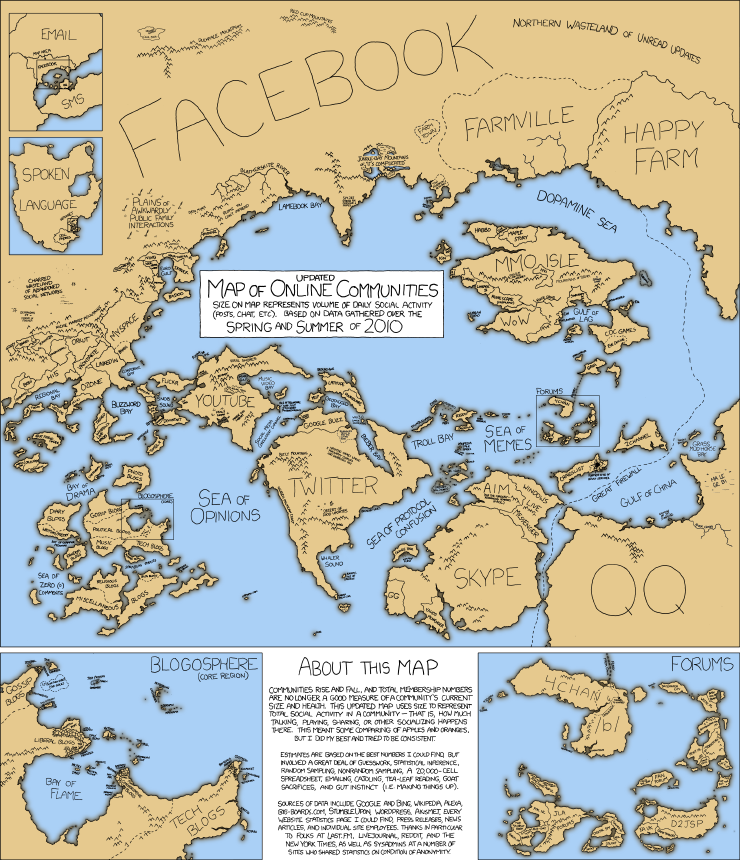
Before I respond to the prompt, I wanted to share with everyone the following webcomic where they actually made a map of all the online communities. It's taken from a webcomic called XKCD that deals with a little bit of everything, but definitely talks a lot about technology and computers. I know that it is a little bit small to read so I definitely suggest checking out the original site at http://xkcd.com/802/
I thought this map was a very interesting way to think about the idea of social networks and really how popular they are and how many millions of people use them on a daily basis.
Getting back to the readings, one of the things I found most intriguing about this weeks readings was the idea of social networking and public versus private information as well as the effect that this has on the connections we make. I was especially interested in the idea of the distinction between professional and personal. I think especially because I know so many soon to be teachers it is an important distinction to make when it comes to online social networking. I think every person has different sides of themselves, and not because they are purposely deceiving their friends and family but I think everyone needs different sides of themselves depending on the occasion. For example I would act a slightly different way with my best friends than I would with my coworkers or with my family. Sometimes I think those personas can overlap, but for the most part they tend to stay separate. Going back to the example of the teacher. If a teacher lets their students into their personal life then they are changing the student-teacher relationship into something else, which can mean that some of the fundamental ideas that happen in that relationship may disappear. Certain relationships are the way they are because they exist for a specific purpose. The student-teacher relationship exists in order to help give the teacher the respect and power they need in order to teach. When you start to blur the lines between those different relationships the fundamental ideas start to vanish and can hinder the working relationship the two people have.
It kind of reminds me of the book "My Teacher Sleeps in School" because in that book the student-teacher relationship is clearly identified. It would be a very different situation if the student could just look at facebook and see pictures of their teachers home or something like that.
To bring the idea to a different example I think about my own online social networking style. I know that people use facebook as their professional profile. For me, I could never do that. I use it strictly for personal use and even go so far as to block different types of information about myself to anyone who should not have access to that part of my life. I think thats why it is important for sites such as Linked In to exist so that there can be those clear cut lines between the professional realm and the private realm.
Tuesday, October 26, 2010
Wednesday, October 20, 2010
Response for Oct 21st
After reading the article that I critiqued for last week (about utilizing social networking media to appeal to newer generations of learners) I have really become interested in how websites and programs that are really made for entertainment sharing purposes from the start can then become implemented into educational design. For example, I would never have thought of Flickr as being useful when it came to education, but as I found out through the article and during the last class, it actually has been used in classes and can be a great platform for sharing images and for creating discussion about those images. I think it's great that we as educators can take existing programs that are just free and out there on the web and then be able to mold them for educational purposes. I don't think the creators of Second Life, for example, were thinking they would spawn this niche as an online education meeting space when they first created this virtual world. (Or maybe they are, I could be wrong ^_^)
I think as I move forward I need to find readings that research more of these programs in depth. I think the overview gave me a good starting point and then I can dive into some of the areas the article was talking about. I would also be interested in looking at how the different types of media play against each other. For example, how is something like YackPack (basically asynchronous voice messages) help in an educational setting versus something like a text based discussion board. Is one better than the other in general? Or would it depend on the situation? I also think it would be interesting to expand further on the idea of a "neomillennial learner", whether such a thing even exists, and/or how that effects teaching methods.
Tuesday, October 5, 2010
Response for Oct 7th
One of the themes that seems to pop up in my writing is the idea of how we should and do relate to technology and whether or not we drive it, or it drives us. I do realize how broad of a topic this is, but I think it is an important one that perhaps we as humans are still finding out. I think that seems to be at the heart of many of the issues involving technology. I think most of the time we just don’t know how to approach it. Part of this probably stems from the face that the word “technology” doesn’t really mean anything. Depending on the context, technology can be anything from the concept of fire to the internet, so I think that is one of the reasons why it is so hard to pin point exactly how we feel about such a creation. Clearly there is different ways to interact with different types or aspects of the technology.
I think my questions have narrowed a bit more since my first post because realizing that there is no proper way to interact with that almighty “technology”, the questions then become how do we interact with the smaller parts that technology encompasses. So now, instead of asking about our relationship with technology as a whole, I’m more interested in certain aspects such as how we interact with something that is constantly changing? Or realizing that maybe in the end it doesn’t matter if the history comes first and technology second or visa versa, but that what matters is the progression of the human race and using what we have to best of our abilities and if our abilities get us to create something else, so be it. It also gives me the freedom to be able to interact with different aspects of technology in different ways. I think interacting with Facebook is a very different thing than using a supercomputer to restructure our DNA for example, but it’s okay because not every aspect needs to hold the same weight and can be used to perform different functions in society.
Saturday, October 2, 2010
A new way of interacting with the Internet?
I read this recently, and thought maybe people would be interested since I think it goes along with our discussion on Thursday about whether people are more public about their lives now than they used to be. Well, Seth Green, who is probably known best for shows like Family Guy and Robot Chicken, is going to start a new reality web series called Control TV. From what I've read, the basic concept is that this 25 year old guy will basically have his entire life taped for 6 weeks and as the footage goes online as a webisode, the audience is supposed to vote on everything from what he should eat to who he should date etc. It's supposed to Talk about making your life public on the internet!
Here's the official site where it will play. It starts October 6th!
Subscribe to:
Posts (Atom)


